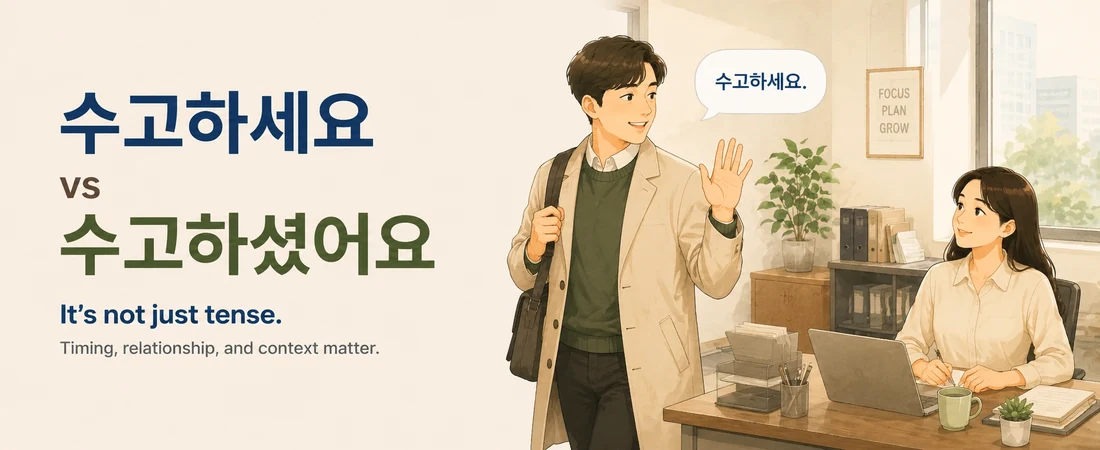
수고하세요 vs 수고하셨어요 looks like a simple present-versus-past contrast. If you leave a Korean office while someone else is still working, you may hear—or say—수고하세요.
When a meeting, shoot, class, or other task has just finished, you are more likely to hear 수고하셨어요 or the more formal 수고하셨습니다.
That makes the difference look simple: present tense for work that is continuing, past tense for work that is finished.
That rule is useful. It is also incomplete.
In real Korean, these expressions do more than describe when the work happens. They acknowledge someone’s effort, and that means your relationship with the other person matters too.
Quick Answer
수고하세요 is commonly used when the other person is still working or will continue working. 수고하셨어요 acknowledges effort that has already been made or a task that has just ended.
But do not choose between them by tense alone. In workplaces especially, hierarchy, age, local office culture, and the reason you are speaking can matter as much as whether the work is finished.
Why “good job” is not quite right
Learners often meet 수고하셨어요 as “good job” or “thank you for your hard work.” Both translations can be useful, but neither explains the expression completely.
Good job usually sounds as if you are evaluating the result: You did that well.
수고하셨어요 often focuses less on the result and more on the effort itself: You put work into that. I recognize it.
That is why it appears in places where English might use completely different phrases.
After a long meeting, a Korean coworker might say:
오늘 수고하셨어요.
A natural English response might be “Thanks for today,” “Good work today,” or simply “See you tomorrow,” depending on the relationship and situation.
The Korean sentence is not a word-for-word match for any one of them.
When Koreans say 수고하세요
Imagine you are leaving work, but your coworker is staying to finish something.
You might say:
Real Example
저 먼저 들어갈게요. 수고하세요.
The second sentence does not literally function as “work hard.” In this situation, it works more like an acknowledgement that the other person still has work ahead of them.
This is why 수고하세요 is often associated with ongoing effort.
You may also hear it in service situations. Someone gets out of a taxi and says 수고하세요 to the driver. A customer leaves a shop while the employee continues working. The speaker is leaving, while the other person’s work continues.
So a useful mental picture is:
I’m leaving; you’re still doing the work → 수고하세요 can fit.
But there is an important limit to that shortcut, especially in a workplace: who is the other person?
When Koreans say 수고하셨어요
Now imagine the work has ended.
A meeting finishes. A team wraps up a shoot. Someone helps you with a task. At that point, you may hear:
오늘 촬영 수고하셨어요.
or, in a more formal setting:
다들 오늘 수고하셨습니다.
Here the speaker is looking back at effort that has already happened.
That makes 수고하셨어요 a natural acknowledgement after completion.
The form itself also contains a useful grammar clue. The -시- in 하셨어요 is the subject-honorific marker, and the past marker -었- points back to the completed effort. 수고하셨습니다 carries the same basic idea in the more formal 합니다체 style.
But this is where Korean gets interesting: a grammatically honorific form is not automatically the safest social choice in every relationship.
The hierarchy trap
A learner can reasonably think:
수고하셨어요 has an honorific marker, so it should be polite enough for my boss.
Grammatically, the form does raise the person whose effort you are talking about. Socially, however, traditional Korean language-etiquette guidance has been more cautious.
The concern is not that -시- is missing. The concern is the act of evaluating or commenting on a superior’s effort from a lower position.
For that reason, National Institute of Korean Language guidance has repeatedly noted that expressions using 수고하다 or 고생하다 toward a superior can be perceived as inappropriate in conservative etiquette terms.
Key Nuance
Honorific grammar tells you how the sentence is formed. Social hierarchy affects whether that sentence is the best thing to say.
Those are related questions, but they are not the same question.
So do Koreans actually avoid saying it to bosses?
Not always.
This is one of those places where a clean textbook rule and real workplace language do not line up perfectly.
Culture Note
The same language-etiquette discussions that warn against using 수고하다 upward also acknowledge that expressions such as 수고하십시오 or 수고하셨습니다 are commonly heard in real workplaces. Many speakers use them as routine closing expressions without feeling that they are deliberately “judging” a superior.
The disagreement is still active. In August 2026, a question submitted to the National Institute of Korean Language explicitly argued that 수고하셨습니다 has become a conventional expression of recognition and thanks in modern workplaces and asked whether the older etiquette guidance should be reconsidered. The institute said the suggestion would be forwarded to the relevant department for review.
That tells you something important as a learner: there is no single rule that perfectly describes every Korean workplace.
Some teams use 수고하셨습니다 freely across ranks. Some speakers—especially in more conservative relationships—prefer not to use it upward. A phrase that sounds completely routine in one office may feel slightly awkward in another.
What should you say to a superior?
If you are not sure about the local norm, you do not need to solve the entire etiquette debate on your first day at work.
Use a phrase that says exactly what you mean.
If you are leaving before your boss:
먼저 들어가겠습니다.
“I’ll head out first.”
You can also add:
내일 뵙겠습니다.
“See you tomorrow.”
If the person specifically helped you:
도와주셔서 감사합니다.
“Thank you for helping me.”
These phrases avoid the question of whether you are in a position to comment on the person’s effort.
And once you have spent some time in the workplace, notice what people around you actually say. Korean workplace language is learned partly through grammar and partly through local relationship norms.
A practical situation guide
Situation Guide
Your coworker is staying late while you leave
저 먼저 들어갈게요. 수고하세요.
Natural when the relationship allows it and the other person’s work is continuing.
You and a coworker just finished a task
오늘 수고하셨어요.
Acknowledges the effort that has just ended.
A team or group has finished something
다들 수고하셨습니다.
A formal group-level acknowledgement commonly heard after work, meetings, events, shoots, and similar shared tasks.
You are leaving before a senior person
먼저 들어가겠습니다. 내일 뵙겠습니다.
A conservative, low-risk choice when you do not know whether the workplace uses 수고 upward.
A service worker has helped you
Depending on the situation, Koreans may use 수고하세요, 수고하셨어요, or simply 감사합니다.
The choice can reflect whether the person’s work is continuing, whether the service for you has just ended, and the speaker’s own habits.
Common mistakes learners make
Common Mistakes
Mistake 1: Treating the difference as tense only
“Work is continuing = 수고하세요; work is finished = 수고하셨어요” is a useful first approximation.
It is not a complete usage rule.
Relationship and situation can override the simple tense logic.
Mistake 2: Assuming -시- makes anything safe for a superior
-시- is an honorific marker. It does not erase the social meaning of the verb or the speaker’s position relative to the listener.
This is why 수고하셨습니다 can be grammatically respectful while still being debated as a workplace-etiquette choice.
Mistake 3: Translating everything as “good job”
If you translate every 수고하셨어요 as “good job,” you may imagine Koreans constantly evaluating one another’s performance.
Often they are doing something subtler: acknowledging that the other person has put in effort and closing the interaction appropriately.
Mistake 4: Memorizing 고생하셨습니다 as the “more respectful” version
고생하다 and 수고하다 have different lexical meanings, but you should not build a simple hierarchy such as:
수고 = junior → 고생 = senior
Traditional etiquette guidance can be cautious about both when they are directed upward.
수고하세요 vs 수고하셨어요: three questions to remember
Practical Takeaway
When you are deciding what to say, ask yourself:
- Is the other person’s work still continuing?
수고하세요 may fit. - Has the work or effort just finished?
수고하셨어요 or 수고하셨습니다 may fit. - What is my relationship to this person?
With a superior, especially in an unfamiliar workplace, a direct farewell or thank-you can be safer than relying on 수고.
That is more useful than memorizing one English translation.
수고하세요 and 수고하셨어요 are not simply Korean versions of “good job.” They show how Korean speakers can use a farewell to recognize work, effort, timing, and relationship all at once.
And that is exactly why the expression feels so ordinary to Koreans—and so difficult to translate cleanly.