Latest posts
-
어떡해 vs 어떻게: They Sound Almost the Same, but Do Different Jobs

어떻게 and 어떡해 can sound almost the same, but they do different jobs. Learn the structural rule, real conversational use, pronunciation trap, and why 어떡해! can sound like “Oh no!”
-
근데 Is More Than “But”: Why Koreans Start So Many Sentences With It

If you search geunde meaning, you will often find “but.” But real Korean conversations can get confusing very quickly. You might hear: 근데 너 오늘 뭐 해? There is no obvious contrast. Nobody just said something that needs a “but.” So what is 근데 doing there? Quick Answer The short answer is that 근데 can…
-
좀 Doesn’t Just Mean “a Little”: Why Koreans Use It in Requests

좀 can mean “a little,” but in everyday Korean requests it often changes how direct the request feels. Learn how to tell literal quantity from request-softening use.
-
놓다 vs 두다: What’s the Difference in Korean?

놓다 and 두다 can both mean “put” in Korean. See when each feels more natural, where they overlap, and why -아/어 두다 often sounds right for preparing in advance.
-
아쉽다 vs 섭섭하다: They Both Mean “Disappointed”—So What’s the Difference?

If you are looking for the difference between 아쉽다 vs 섭섭하다, English translations can make them look almost the same. Depending on the dictionary or situation, you may see words such as disappointed, sorry, regretful, or a shame. But Koreans do not choose between 아쉽다 and 섭섭하다 by translating an English feeling first. The more…
-
Yakgan (약간) Meaning: Why Koreans Say It So Much
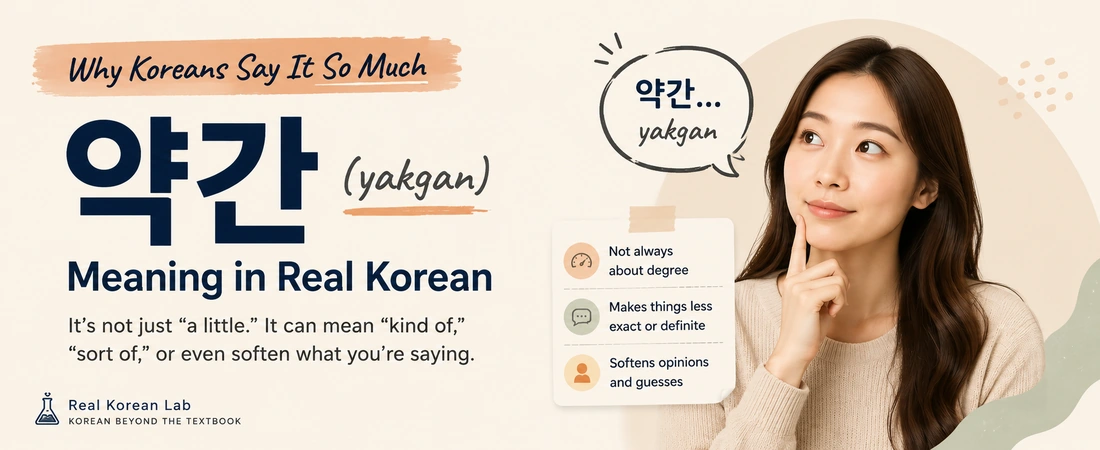
약간 does not always mean “a little.” See how Koreans use it for degree, approximation, uncertainty, softened opinions, and natural conversational flow.
-
Gwaenchanayo Meaning: Why 괜찮아요 Can Mean Yes or No

If you have studied Korean for even a short time, you have probably learned 괜찮아요 (gwaenchanayo) as: Those translations are correct—but they are not enough to understand how Koreans actually use the expression. At a restaurant, you might hear this: 직원: 반찬 더 드릴까요?손님: 아, 괜찮아요. Staff: Would you like some more side dishes?Customer: No,…