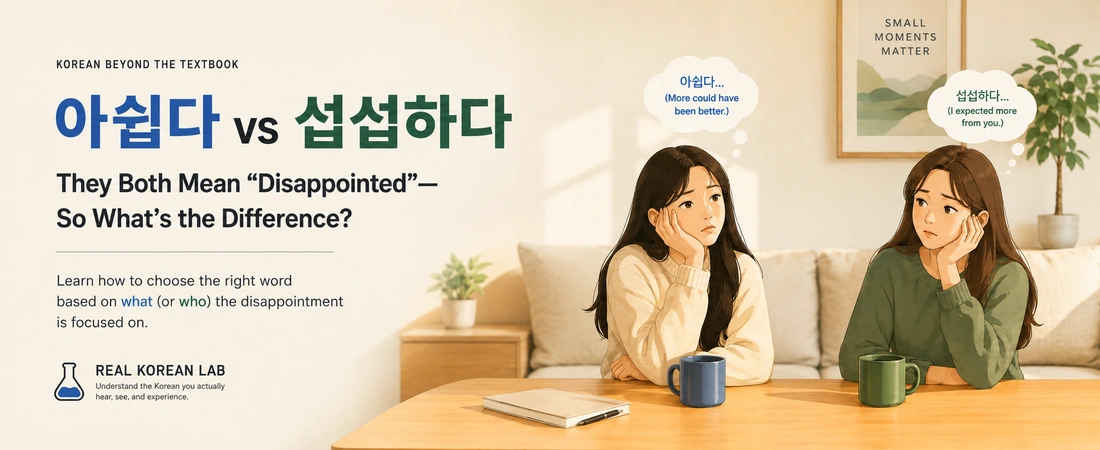
If you are looking for the difference between 아쉽다 vs 섭섭하다, English translations can make them look almost the same. Depending on the dictionary or situation, you may see words such as disappointed, sorry, regretful, or a shame.
But Koreans do not choose between 아쉽다 and 섭섭하다 by translating an English feeling first.
The more useful question is:
What is the disappointment focused on?
Quick Answer
아쉽다 usually focuses more on a result, missed chance, lack, amount, time, or something that could have been better.
섭섭하다 more easily carries the feeling that an expectation was not emotionally met. This often happens with someone’s attitude, attention, or a relationship.
But this is not a hard “situation vs person” rule. The two words can overlap, especially when someone leaves, an opportunity disappears, or something you were looking forward to is cancelled.
That overlap is exactly why simple translations are not enough.
Think of 아쉽다 as “I wish there had been more”
One core idea behind 아쉽다 is that something feels not quite enough.
Maybe you needed more time. Maybe you almost succeeded. Maybe the result was good, but it could have been better.
For example:
아, 1점 차이였는데 너무 아쉽다.
Ah, it was only one point. That’s such a shame.
The speaker is reacting to the result. They were close, and that makes the outcome feel especially disappointing.
Another example:
시간이 조금만 더 있었으면 좋았을 텐데. 아쉽네.
I wish we had had a little more time. Too bad.
Here, the feeling comes from not having enough time.
You can also use 아쉽다 when judging something that was acceptable but could have been better:
이번 경기 결과는 좀 아쉬웠어요.
The result of this game was a little disappointing.
This does not necessarily mean the speaker feels personally hurt. It can simply be an evaluation: the result fell short of what was possible or hoped for.
섭섭하다 often has an emotional expectation behind it
With 섭섭하다, the missing thing is often more emotional.
You expected someone to care, notice, stay longer, react differently, or treat you in a certain way. When that expectation is not met, you may feel 섭섭하다.
For example:
내 생일인데 연락도 없어서 좀 섭섭했어.
It was my birthday, and you didn’t even contact me, so I felt a little hurt/disappointed.
The problem is not simply that “a message was missing.” The speaker expected attention from this person.
That makes 섭섭하다 feel more personal.
Another example:
그렇게 말하니까 좀 섭섭하다.
Hearing you say that makes me feel a little hurt.
Again, disappointed is possible in English, but it does not fully show the nuance. The Korean sentence can suggest, “I expected something different from you, so this feels emotionally disappointing.”
A useful contrast: 태도가 아쉽다 vs 태도가 섭섭하다
Comparison
아쉽다
인터뷰 태도가 좀 아쉬웠어요.
Their attitude in the interview was a little disappointing.
This could have been better.
섭섭하다
네가 그런 태도를 보여서 좀 섭섭했어.
I was a little hurt that you treated me that way.
I expected something different from you.
The key difference is the focus of the disappointment, not the English translation.
This difference becomes easier to see when we compare reactions to someone’s attitude.
Imagine you are commenting on a public figure’s interview:
인터뷰 태도가 좀 아쉬웠어요.
Their attitude in the interview was a little disappointing.
Here, 아쉽다 can sound evaluative. The attitude could have been better.
Now imagine a close friend behaved coldly toward you:
네가 그런 태도를 보여서 좀 섭섭했어.
I was a little hurt that you treated me that way.
Here, 섭섭하다 makes the emotional expectation clearer. You expected something different from this person because of your relationship.
So a useful starting point is:
- 아쉽다 → “This could have been better.”
- 섭섭하다 → “I expected something more from this, or from you.”
But there is an important catch.
Don’t memorize “아쉽다 = situation, 섭섭하다 = person”
Common Mistake
Wrong shortcut: 아쉽다 = situation / 섭섭하다 = person
Both words can appear in parting and other overlap contexts; the adjective changes the emotional focus.
This shortcut sounds convenient, but it breaks quickly in real Korean.
For example, both of these can sound natural when a friend is leaving:
벌써 간다니 아쉽다.
It’s a shame you’re leaving already.
벌써 간다니 섭섭하다.
I’m sad / a little hurt that you’re leaving already.
The event is the same. What changes is the focus.
With 아쉽다, you may be thinking:
I wish we had more time. It’s too bad this is ending.
With 섭섭하다, the emotional side can feel stronger:
I don’t want you to go yet. Your leaving makes me feel emotionally empty or disappointed.
The Korean Basic Dictionary itself gives parting examples for both words, which is a good reminder that these are overlapping emotional adjectives, not two boxes with a perfect border between them.[1][2]
The same thing can feel 아쉽다 or 섭섭하다
Imagine an event you were looking forward to gets cancelled.
A very general reaction is:
행사가 취소돼서 아쉬워요.
It’s a shame the event was cancelled.
The focus is the lost opportunity.
But if you had been looking forward to it for a long time, you might also say something like:
기대 많이 했는데 취소돼서 좀 섭섭하네요.
I was really looking forward to it, so I’m pretty disappointed that it was cancelled.
Now the sentence brings the unmet expectation closer to the surface.
This overlap is not a problem to “fix.” It is part of how emotion words work.
Research on Korean emotional adjectives has found that learners often need information about typical situations and usage contexts, not just dictionary definitions, to distinguish near-synonyms such as 아쉽다, 섭섭하다, 아깝다, 서운하다, and 안타깝다.[3][4]
A simple way to choose between them
Practical Takeaway
- Result / lack / missed chance / could be better? → 아쉽다
- Emotionally unmet expectation? → 섭섭하다
- Both possible? → choose the feeling you want to foreground.
When you are not sure which word to use, ask yourself these questions.
1. Am I focused on a result, lack, missed chance, time, amount, or something that could have been better?
Start with 아쉽다.
Examples:
- You lost by one point.
- Your trip was too short.
- The food was good, but one part could have been better.
- A chance disappeared.
- You wish you had more time.
2. Am I focused on an expectation that feels emotionally unmet?
Consider 섭섭하다.
Examples:
- A close friend forgot your birthday.
- Someone you care about acted unusually cold.
- A person is leaving and you feel emotionally reluctant to let them go.
- You expected more attention, care, or consideration.
3. Do both seem possible?
Then ask one more question:
Which part of the feeling do I want to emphasize?
That is often more useful than searching for the “correct English translation.”
Common mistake: translating first
A learner may think:
“Disappointed” = 섭섭하다.
But imagine you miss a train by ten seconds.
10초 차이로 기차를 놓쳐서 너무 아쉬워.
Here, 아쉽다 is much more natural as a first choice because the focus is the near miss and lost chance.
Now imagine your friend knew you needed help but never checked on you:
알고도 연락 한 번 없어서 섭섭했어.
The disappointment comes from an expectation within the relationship.
Same English word, different Korean focus.
What should you remember?
Do not try to memorize one English word for each expression.
Remember this instead:
아쉽다 often looks at what was missing, what almost happened, or what could have been better.
섭섭하다 often looks at an expectation that was not emotionally fulfilled.
And when the two overlap, especially in partings or meaningful losses, the choice can show which side of the feeling you want to bring forward.
That is a much more useful rule than “아쉽다 is for situations and 섭섭하다 is for people.”
Once you start listening for the focus of the disappointment, the difference becomes much easier to feel in real Korean.
References
- National Institute of Korean Language, Korean Basic Dictionary: 아쉽다.
- National Institute of Korean Language, Korean Basic Dictionary: 섭섭하다.
- Corpus-based research on Korean emotion vocabulary and typical usage contexts.
- Research on teaching near-synonymous Korean emotional adjectives.