If you saw Korean posts about a lantern-headed gentleman from Lotte World in 2026, you may have noticed one unfamiliar word: 인외.
The characters Vesper and Candra were widely described online as 인외 캐릭터. A quick translation gives you “non-human character,” which is not wrong. But it leaves out the part that makes the word useful in Korean.
What Does 인외 Mean?
Quick Answer
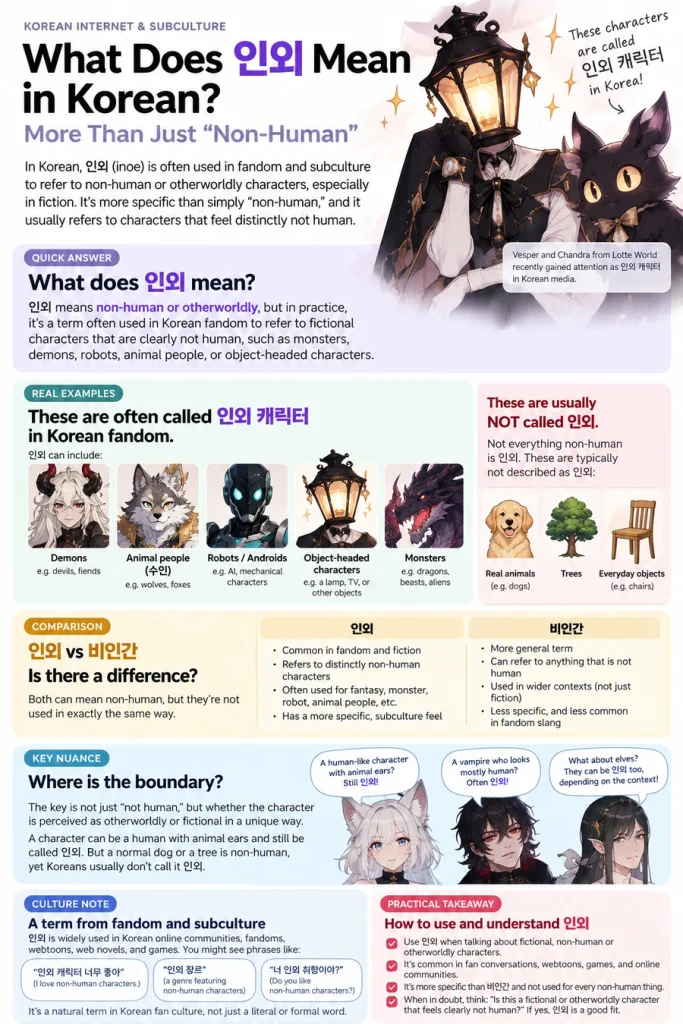
In current Korean fandom and subculture, 인외 refers to a fictional being or character that is outside the human category.
“Non-human” is a good first translation, but the word usually carries a fictional-character and fandom context rather than describing everything that is not human.
The Hanja is 人外: 人 means person or human, and 外 means outside.
So “non-human” is a good first translation.
But do not treat 인외 as a label for everything that is not human.
A dog is not human. A tree is not human. A chair is definitely not human. Koreans do not normally look at all of these things and call them 인외.
The word becomes much more natural when people are talking about fictional characters, species, designs, or fandom preferences.
인외 Is More Like a Character Category
This is the easiest way to understand the word.
Real Example
나 인외 캐릭터 좋아해.
“I like 인외 characters.”
They are not making a philosophical statement about all non-human life. They are talking about the kinds of fictional characters they enjoy.
Depending on the work and the fandom, 인외 can include monsters, supernatural beings, animal-like characters, non-human humanoids, robots, androids, or characters with strongly non-human designs.
One very visible example is an object-head character: a human-shaped body with an object instead of a normal human head.
That is why Lotte World’s Vesper, whose head is shaped like a lantern, was so easily described as an 인외 캐릭터 in Korean posts and news coverage.
Why “Non-Human” Is Not Enough
English “non-human” is extremely broad.
It can describe animals, machines, legal or academic categories, artificial intelligence, and almost anything that is not a human being.
인외 vs 비인간
비인간
A broad “non-human / not human” concept, depending on context.
인외
A fandom or subculture category for a being presented as outside the human category.
The two can overlap, but they do not feel identical and are not always interchangeable.
If you are reading a paper about humans and non-humans, 비인간 may be natural. If someone is talking about a favorite monster, android, or object-head character, 인외 is much more likely to appear.
How Koreans Actually Use 인외
You will often see the word attached to another noun.
Real Examples
인외 캐릭터
“non-human character”
인외 장르
“a genre/category involving non-human beings”
인외 취향
“a preference for non-human character types”
It can also appear by itself when the context is obvious.
인외 좋아해?
Literally, this looks like “Do you like non-humans?”
In a fandom conversation, however, it usually means something closer to:
“Are you into non-human characters?”
That missing word — “characters” — is often supplied by context.
Is There a Clear Rule for What Counts as 인외?
Not really.
This is one reason the word is interesting.
인외 is not a scientific category with an official checklist. Different fandoms and individual fans can draw the boundary differently.
A character can be mostly human-shaped but have a clearly non-human head or body feature. Another character may look almost human but belong to a fictional non-human species. A robot may count in one conversation, while another speaker may use a more specific label.
Key Nuance
Instead of asking, “Exactly how many human features can a character have before it stops being 인외?”, ask:
“Is this character being presented and discussed as something outside the human category?”
That is much closer to how the word works in real use.
Why You May Be Seeing 인외 More Often Now
Culture Note
For a long time, 인외 was much more familiar inside anime, game, web-fiction, illustration, and other fandom spaces.
In 2026, the word became unusually visible outside those spaces when Lotte World’s dark-fantasy characters Vesper and Candra attracted attention on social media. Korean reports began explaining the term while describing the characters as 인외 캐릭터.
That does not mean the word was newly invented in 2026. A term already familiar to subculture fans simply reached a much broader audience.
One More Nuance: 인외 Is Not Just a Literal Translation
The modern fandom sense is connected to Japanese 人外 usage. But the Japanese word has older meanings too, and traditional dictionary definitions are not limited to “non-human fictional character.”
That is another reason it is better to learn 인외 through modern context instead of translating the two Chinese characters mechanically.
For a Korean learner, the most useful rule is simple:
Practical Takeaway
- Is the topic fictional characters or worldbuilding?
- Is the speaker talking about species, design, or character preference?
- Is the being intentionally presented as outside the human category?
If yes, the fandom sense of 인외 is probably what is meant.
The Real Korean Insight
Real Korean Insight
인외 is less about biology than about categorization.
Korean fans use it to group characters that are intentionally presented as outside “ordinary human” design or identity.
So when you see:
이 캐릭터 인외야?
do not translate it too literally as:
“Is this character non-human?”
A more natural way to understand the question is:
“Would people classify this as an 인외 character?”
That small difference is the part a dictionary translation can easily miss.