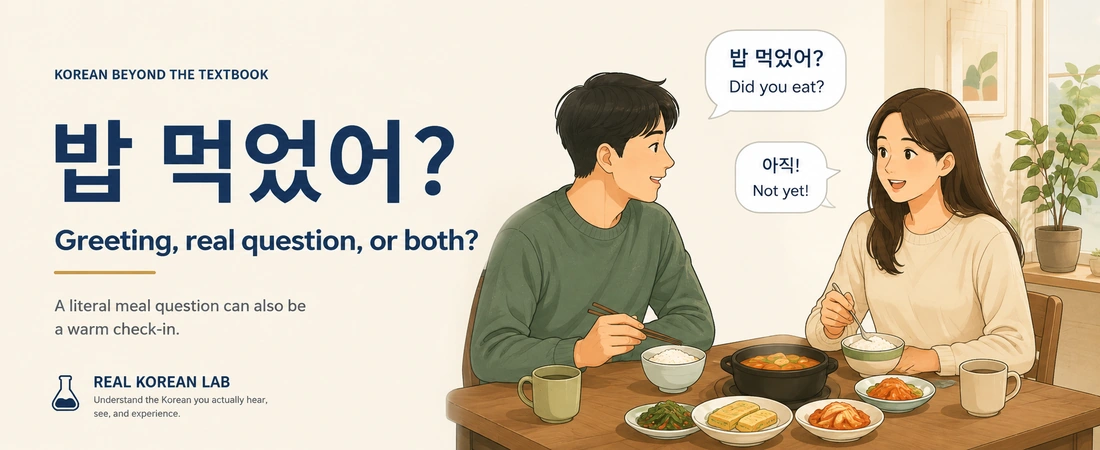
If someone in Korea texts you 밥 먹었어? at 8 p.m., are they asking about dinner—or just checking in?
Often, the answer is both.
밥 먹었어? literally means “Did you eat?” In casual Korean, it can also work as a warm check-in or greeting between people who already know each other. But the food question does not disappear completely.
Quick Answer
밥 먹었어? can be both a real meal question and a social check-in. If someone asks you this, answering 응, 먹었어 (“Yeah, I ate”) or 아직 안 먹었어 (“Not yet”) is completely natural—even when the question also feels like a greeting.
What does 밥 먹었어 literally mean?
Start with the literal meaning.
밥 can mean rice, but in everyday Korean it also commonly means a meal. So 밥 먹었어? is usually closer to:
“Did you eat?” / “Have you eaten?”
—not “Did you eat rice?”
That literal meaning matters because Koreans often really do want to know whether you have eaten.
For example:
A: 밥 먹었어?
B: 아직.
A: 그럼 같이 먹자.A: “Did you eat?”
B: “Not yet.”
A: “Then let’s eat together.”
Here, the answer changes what happens next. Treating 밥 먹었어? as only “How are you?” would miss the point.
So why can it feel like a greeting?
Because questions in Korean do not always exist only to collect information. They can also help open a conversation and show interest in the other person.
Research on Korean greetings has described this kind of pattern as other-oriented: the greeting focuses on the person you are speaking to and their current situation.
That is why a phrase like 밥 먹었어? can feel warmer than a neutral hello in some relationships. It gives the speaker an easy way to check in.
A friend comes home:
어, 왔어? 밥 먹었어?
“Oh, you’re back. Have you eaten?”
The speaker may genuinely care whether the friend ate, but the sentence is also doing social work. It welcomes the person, opens the conversation, and shows attention.
Key Nuance
밥 먹었어? does not have to choose between “real question” and “greeting.” The same sentence can do both jobs at once. Context tells you which function is stronger.
The important part: the question is still real
This is where the common “Korean How are you?” explanation becomes too simple.
A 2017 study asked 144 Korean native speakers in their 20s how they understood and answered interrogative greetings such as 어디 가? (“Where are you going?”) and 밥 먹었어?.
The researchers found that these expressions could function as greetings while still keeping their question function. Many people answered honestly—for example, by saying whether they had eaten.
The study also found that the relationship between the speakers and the situation affected how the question was understood and answered.
So if 밥 먹었어? feels like a greeting, you do not need to invent a vague greeting-style answer. You can simply answer the meal question.
Three situations that change how 밥 먹었어? feels
1. A real meal question is strongest
Situation: You meet a friend around dinner time and might eat together.
A: 밥 먹었어?
B: 아직. 너는?
A: 나도 아직. 같이 먹자.Natural English:
“Did you eat?”
“Not yet. You?”
“Me neither. Let’s eat together.”
Here, the literal meaning is central.
2. A greeting or caring check-in is stronger
Situation: A close family member or friend sees you after you come home.
A: 왔어? 밥 먹었어?
B: 응, 먹었어.Natural English:
“You’re back? Have you eaten?”
“Yeah, I ate.”
No meal plan may follow. The question helps create a caring, familiar opening.
3. Both functions are active
Situation: A friend messages you in the evening.
A: 뭐 해? 밥 먹었어?
B: 아직 안 먹었어.
A: 그럼 뭐라도 먹어.
Natural English:
“What are you doing? Have you eaten?”
“Not yet.”
“Then go eat something.”
The speaker is checking in socially, but the answer still matters.
That mixed function is not an exception. It is one of the most useful ways to understand the expression.
How should you answer 밥 먹었어?
Keep it simple. You can answer the actual meal question.
- 응, 먹었어. — “Yeah, I ate.”
- 아직 안 먹었어. — “Not yet.”
- 응, 방금 먹었어. — “Yeah, I just ate.”
- 아직. 너는? — “Not yet. You?”
If the other person was mainly checking in, these answers still work naturally. The conversation can continue from there.
You usually do not need to answer it like English “How are you?” with something such as “I’m good.”
Common Mistake
Do not memorize 밥 먹었어? = How are you? That shortcut explains the social feeling, but it hides the fact that Koreans often still care about the literal answer.
Is this really about food—or about care?
Food is the topic of the sentence, but the interaction can carry more than food information.
Korean greeting research shows that greetings often reflect the relationship between speakers and can express concern for the other person. 밥 먹었어? fits naturally into that pattern because it asks about something ordinary and immediate in daily life.
That does not mean every Korean uses it the same way, or that every use is deeply emotional. Sometimes it is simply a practical question. Sometimes it feels warm. Sometimes it is both.
It is better to learn the interaction pattern than to attach one big cultural explanation to every example.
A useful way to read 밥 먹었어? is as an other-focused check-in. The speaker is asking about something concrete in your day, and that concrete question can also create warmth or familiarity.
What about 밥 먹었어요? and 식사하셨어요?
밥 먹었어? is casual, so it fits close friends, family members, or people who normally speak casually with each other.
You may also hear:
- 밥 먹었어요? — a polite version used in many everyday situations
- 식사하셨어요? — a more polite meal-related question
The exact form depends on the relationship. But the same basic idea can remain: a question about eating may also work as a social check-in.
The easiest way to understand it in real life
When you hear 밥 먹었어?, do not rush to choose one English translation.
Instead, look at what happens next.
Practical Takeaway
- Does the answer decide whether you will eat together? The literal meal question is probably strong.
- Is the speaker mainly opening a conversation or checking on you? The greeting function is stronger.
- Could both be true? Very often, yes.
When someone asks 밥 먹었어?, a short, honest answer about whether you ate is a safe and natural response. Then use the next line of the conversation to understand whether the speaker was planning a meal, checking in, or doing both.